
From “sticking plaster” to permanent fix: why Sentinel is the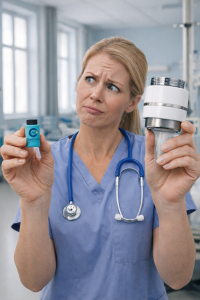 smarter long‑term strategy
When a hospital faces a spike in Pseudomonas or Legionella, it’s common tosee point‑of‑use (POU) filters go on taps and showers. They’re quick, familiar and, critically, they work as an interim safeguard—especially in augmented care—while root causes are identified and corrected. But the national guidance is clear: POU filters are an interim, not a permanent, measure.
What the guidance actually says
NHS England’s HTM 04‑01 (Part B) and related UK guidance position POU filters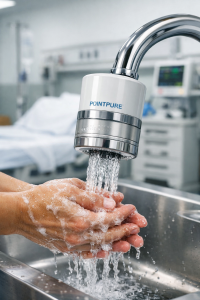 as temporary controls—to protect patients whileengineering fixes, remedial works or operational improvements are put in place, or where additional protection is briefly required for very high‑risk patients. Long‑term continuous use is not recommended unless no effective alternative exists and must be reviewed by the Water Safety Group. [england.nhs.uk],
The Scottish NIPCM (Built Environment) echoes this: fit POU filters where a clinical risk from water is identified, replace per manufacturer intervals, and remove once water quality can be maintained without them. [nipcm.scot.nhs.uk]
And in practical terms, the UK MHRA notes POU hospital water filters are not medical devices—a reminder that their presence doesn’t replace the obligation to fix the system. [assets.pub…ice.gov.uk]
The real‑world limits of POU filters
Let’s be fair: POU filters reduce exposure and can help interrupt transmission 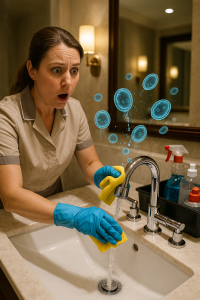 during incidents or in specific high‑risk areas. Studies show short‑term reductions in Legionella and other pathogens at outlets, and some models retain performance for weeks to a couple of months. [healthdesign.org]
But filters must be managed—changed on time, kept clean externally, fitted correctly, and documented—or they become risks in their own right (retrograde contamination, splash, flow restriction, user error). Evidence reviews highlight the operational burden and confounding risks around long‑term reliance. [journalofh…ection.com]
They also don’t remove upstream biofilm in taps, mixers, hoses or drains. We now have strong evidence that sinks, drains and outlet hardware are persistent reservoirs for waterborne pathogens and can re‑seed outlets quickly after cleaning—often within 24 hours. [journalofh…ection.com], [researchno…ers.edu.au],
Bottom line: POU filters are an excellent sticking plaster during incidents and for tightly defined clinical indications. They’re not a system fix.
Sentinel taps & showers: engineering‑in a permanent barrier
Sentinel taps and showers integrate back‑contamination prevention at the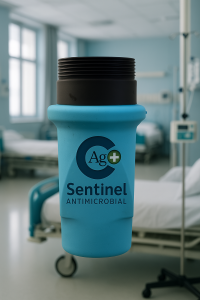 outlet—the critical interface where patient exposure happens. Two pillars underpin the design concept:
- Silver‑based antimicrobial action
Silver ions are broad‑spectrum antimicrobials with a long history in water hygiene. Their activity (the oligodynamic effect) disrupts microbial membranes, enzymes and nucleic acids; modern reviews confirm dose‑dependent bactericidal action and synergy with other controls. [books.rsc.org], [link.springer.com], [frontiersin.org] - Mechanical one‑way protection (duckbill check action)
An elastomeric duckbill non‑return valve is a simple, low‑cracking‑pressure check mechanism that opens under forward flow and self‑seals against back‑pressure—minimising retrograde ingress from contaminated downstream zones (e.g., spray, drain aerosol, handling). The concept is well‑established in fluid hygiene applications.
Used together in Sentinel, these measures create a persistent, passive barrier at the point that matters most—reducing the risk that outlets become re‑colonised between cleans or during routine use, and doing so without the consumable overhead of disposable filters.
Why a permanent Sentinel solution outperforms a permanent POU policy
1) Aligned with UK guidance intent
Guidance prioritises engineering and operational control (design, 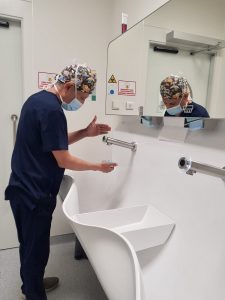 maintenance, temperature/disinfection, outlet selection) with POU filters as interim or special‑case safeguards. A Sentinel‑style outlet that builds in a barrier supports that intent by removing dependence on consumables for baseline control. [england.nhs.uk], [hse.gov.uk]
2) Cuts recurring costs and complexity
POU filters require regular change‑out (often 31–62 days), training, stock management and waste handling—costs that scale rapidly across estates. Even where short‑term cost‑effectiveness has been shown, it’s explicitly incident‑driven; the economics shift unfavourably when filters are used indefinitely. [healthdesign.org], [ajicjournal.org]
3) Targets the outlet biofilm problem
Hospitals battle fast biofilm recolonisation at drains and outlet components; splash and handling drive re‑seeding. A Sentinel outlet’s mechanical one‑way action helps interrupt retrograde paths that filters simply do not address. [journalofh…ection.com],
4) Reduces risk of “filter failure modes”
Long‑term filter deployment brings risks: overdue replacements, flow restriction, external housing contamination, and compatibility issues (e.g., splash geometry). Reviews emphasise the behavioural and system confounders in real‑world wards. An engineered outlet simplifies the task for clinical teams. [journalofh…ection.com]
5) Supports sustained infection‑risk reduction
Multiple UK and international reports tie water outlets to Pseudomonas transmission, with significant gains when engineering at the outlet is improved. Building a permanent barrier at the outlet is exactly the kind of sustainable control estates teams are moving towards. [journalofh…ection.com], [ajicjournal.org]
“Why not wait?”—on the evidence for silver & mechanical backflow prevention
Silver: The antimicrobial efficacy of silver (ionic and nano‑enabled release) 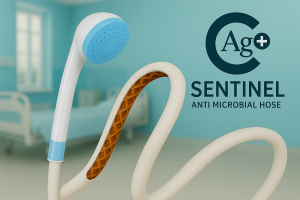 against healthcare‑relevant bacteria is extensively documented, including mechanism and synergy. Its use in water hygiene has deep provenance, albeit with sensible dosing controls. The science is not speculative. [books.rsc.org], [link.springer.com]
Duckbill non‑return: Elastomeric duckbill valves are a mature one‑way technology used widely because they self‑seal without springs, offer low opening pressure and minimal dead‑space, and are resistant to fouling—exactly what’s needed at an outlet to resist retrograde contamination. [minivalve.com]
Together, these are well‑proven principles—which is why there’s no good reason to delay adopting a permanent, engineered barrierat outlets instead of defaulting to an indefinite filter regime. [england.nhs.uk]
Clear, practical conclusions
- POU filters are for interim control. Use them rapidly and confidently during incidents and for very specific high‑risk cases—but don’t rely on them forever. That’s what HTM 04‑01 and allied guidance tell us. [england.nhs.uk],
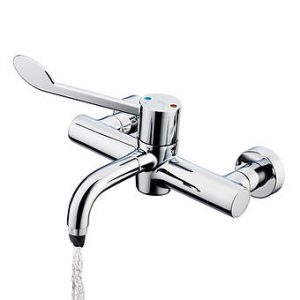
- Sentinel outlets hard‑wire protection at the clinical interface using silver‑based antimicrobial measures and duckbill check action to reduce back‑contamination risks between maintenance cycles. [books.rsc.org], [minivalve.com]
- Long‑term, this approach is simpler, leaner and safer than a permanent filter policy: fewer consumables, fewer behaviour‑dependent failure modes, and better alignment with the engineering‑led control hierarchy. [journalofh…ection.com]
Call to action
If you’re currently juggling incident filters, short replacement cycles and  splash‑zone workarounds, let’s stop firefighting.
Book a short review with our team to see how Sentinel taps and showers can be deployed quickly as a permanent back‑contamination prevention strategy across your high‑risk outlets—complementing your Water Safety Plan and reducing relianceon transitory POU filters. We’re here to help with specification, trials and estates rollout.
Sources & further reading
- NHS England HTM 04‑01: Safe water in healthcare premises (Parts A–C; 2016, page updated Aug 2024). [england.nhs.uk]
- Water Hygiene Centre: POU filters are a temporary control measure—HTM 04‑01 Part B explained. [waterhygie…centre.com]
- NIPCM (Scotland), Built Environment: 4.1.6 POU filters—use, replacement and removal once water quality is stable. [nipcm.scot.nhs.uk]
- MHRA: Regulatory classification—POU hospital water filters are not medical devices in the UK. [assets.pub…ice.gov.uk]
- Outlet‑linked transmission & engineering interventions: Journal of Hospital Infection (2019); AJIC (2018). [journalofh…ection.com], [ajicjournal.org]
- Rapid recolonisation at drains/outlets: JHI (2025); Infection Control Today review (2025). [journalofh…ection.com], [infectionc…ltoday.com]
- POU effectiveness & limits: field and narrative reviews. [healthdesign.org], [journalofh…ection.com]
- Silver antimicrobial mechanisms & water hygiene background. [books.rsc.org], [link.springer.com]