
There’s a quiet honesty emerging in parts of the healthcare sector right now —  and if you listen closely, it’s beginning to challenge some long-held assumptions.
Because despite years of innovation, investment, and intervention… many sites are still seeing the same problems return.
Pseudomonas doesn’t disappear.
It fades… then comes back.
Again.
And again.
So the uncomfortable question is this:
Is the problem really the outlet… or have we been solving the wrong part of the system?
The Reality Few People Say Out Loud
In a recent exchange, Andy Hallam, Deputy Head of Estates and Responsible Person (Water) at Leeds Teaching Hospitals NHS Trust, shared a perspective that will resonate with many — even if it’s not always openly discussed.
The challenge, as he describes it, isn’t a single point failure.
It’s systemic.
- Overly complex water and waste systems
- Practices that unintentionally feed contamination
- Cleaning regimes that can’t fully address what’s building beneath the surface
- A reliance on interventions that treat symptoms, not causes
And perhaps most critically…
An industry tendency to keep adding solutions to the same problem, without addressing why it exists in the first place.
When Engineering Becomes a Distraction
There’s no shortage of innovation in plumbing and water systems. New designs. 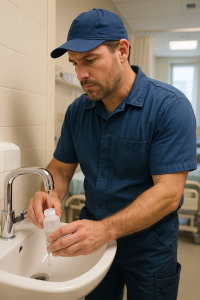 New materials. New technologies.
However, there’s a risk here.
When engineering becomes the primary focus, it can unintentionally create a false sense of security.
A belief that:
“If we fix the outlet… we’ve fixed the problem.”
But the reality is more complex.
Because contamination is not always originating where we measure it.
It’s often being driven by what’s happening further down — in the waste system itself.
What’s Really Driving the Risk?
Strip things back, and a more human picture emerges.
Basins used as disposal points for drinks, bodily fluids, and general waste.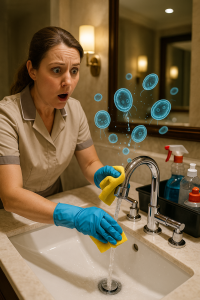
Foreign materials entering drainage systems and disrupting flow.
Slow drains going unreported until they become biofilm reservoirs.
Cleaning practices that can’t fully reach — or remove — what’s established below the surface.
All of this creates an environment where bacteria don’t just survive…
They thrive.
And in that context, no single intervention — however well designed — is ever going to solve the problem on its own.
A Different Way of Thinking
What stood out most in Andy’s reflections wasn’t just the identification of the problem…
It was the clarity around the solution.
Because rather than looking for a single fix, the focus shifts to reducing exposure across the entire system.
That means:
- Addressing Behaviour at Source
Ensuring outlets are used for their intended purpose.
Reducing misuse that inadvertently fuels contamination.
- Making Cleaning More Effective
Not just cleaning more — but cleaning better.
Removing barriers, improving access, updating SOPs so they reflect real-world conditions.
- Creating Visibility Around Failure
Encouraging early reporting of slow drainage.
Treating warning signs as critical, not secondary.
- Improving System Design and Layout
Reducing unnecessary outlets.
Positioning them more thoughtfully in relation to patients and risk zones.
- Strengthening Clinical Ownership
Shifting responsibility away from being purely engineering-led.
Engaging clinical teams directly in driving behavioural change.
Because ultimately…
If the behaviour doesn’t change, the outcome rarely does.
Where Do Point-of-Use Solutions Fit?
This is where the conversation becomes more balanced — and more realistic.
Because acknowledging the limitations of engineering doesn’t mean abandoning it.
Far from it.
It simply means understanding its role more clearly.
And that role is not to “solve” the problem outright…
But to reduce the residual risk that remains once everything else is done well.
The Case for a Layered Defence
In complex environments, resilience rarely comes from a single intervention.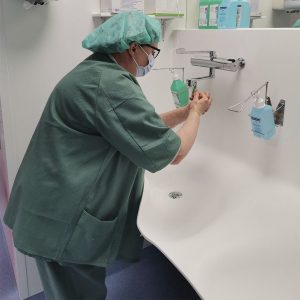
It comes from layers.
Each one doing its job — quietly, consistently — to reduce overall exposure.
Behaviour.
Cleaning.
Design.
Training.
Monitoring.
And yes…
Technology at the outlet.
This is where solutions such as Sentinel units come into their own.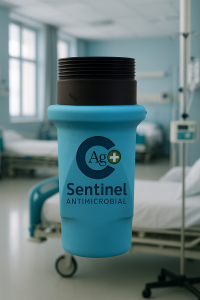
Not as a headline act.
Not as a replacement for good practice.
But as an additional layer of protection — particularly in those environments where, despite best efforts, risk cannot be entirely removed.
A More Honest Way Forward
Perhaps the most valuable takeaway from this conversation is the shift in mindset.
Moving away from:
“What product will fix this?”
And towards:
“How do we reduce risk across the entire system?”
Because when you look at it that way, everything becomes clearer.
No single intervention carries the burden.
No one team owns the entire solution.
And no false promises are made.
Just a structured, practical, and honest approach to risk reduction.
A Personal Thank You
It’s only right to acknowledge the insight and openness of Andy Hallam in shaping this thinking.
The willingness to challenge assumptions — and to focus on what actually works in practice — is not only refreshing, but essential if we’re going to make meaningful progress in this area.
Final Thought
If there’s one thing this reinforces, it’s this:
Effective control isn’t about finding a better “fix”.
It’s about building a better system.
And in that system…
Every layer counts.