
The Hidden Cost of Five Contaminated Taps
When Pseudomonas aeruginosa is detected in a hospital water system, most 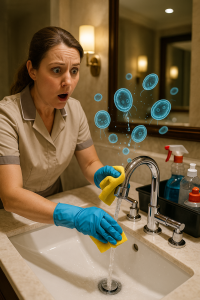 people immediately think about the obvious costs.
Water sampling.
Laboratory testing.
Engineering investigations.
Replacing taps.
But those costs are often just the tip of the iceberg.
The real financial impact spreads far beyond the affected outlets, touching clinical services, estates teams, infection prevention staff, patient flow, bed capacity and hospital operations. In many cases, the most expensive consequences are the ones that never appear on a purchase order.
Let’s look at a realistic example.
A Typical NHS Scenario
Imagine a 500-bed NHS hospital in the South East of England identifies Pseudomonas contamination in five taps on a general medical ward.
The response is immediate.
Additional water samples are taken. Infection prevention teams become involved. 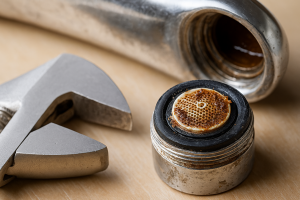 Estates staff begin investigations. Risk assessments are carried out. Senior managers are briefed. Control measures are introduced.
Within hours, what started as five contaminated taps has become a Trust-wide issue.
The Direct Costs
The initial expenses are relatively straightforward to calculate.
Additional sampling and laboratory analysis can easily cost between £3,000 and 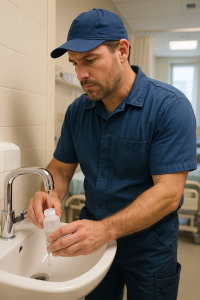 £5,000.
Engineering investigations and remedial works may add another £3,000 to £5,000.
Replacing contaminated outlets could cost several thousand pounds more.
Before long, the Trust may have spent £10,000 to £15,000 simply understanding and addressing the immediate problem.
But this is where the real story begins.
The Hidden Costs
Investigations take people away from their normal duties.
Estates managers, infection prevention specialists, ward managers, clinicians  and senior leadership teams all become involved.
Dozens, sometimes hundreds, of staff hours can be consumed managing an incident that originated from just a handful of water outlets.
Those hours have a cost.
More importantly, they represent time that could have been spent elsewhere improving patient care, managing projects or delivering operational efficiencies.
Bed Closures and Lost Capacity
If affected rooms or bays need to be taken out of use while investigations take place, the costs rise dramatically.
Even a small number of temporarily unavailable beds can have a significant  impact on patient flow.
Admissions may be delayed.
Patients may need relocating.
Pressure on neighbouring wards increases.
Emergency departments feel the knock-on effect.
What appears to be a water hygiene issue quickly becomes an operational challenge affecting the wider hospital.
The financial impact can run into tens of thousands of pounds within days.
The Cost of Patient Risk
Fortunately, most Pseudomonas detections are identified before patient harm occurs.
However, if even one vulnerable patient develops an infection linked to  contaminated water outlets, costs escalate rapidly.
Additional treatment.
Extended hospital stays.
Clinical investigations.
Root cause analysis.
Potential legal costs.
The financial implications can be substantial, but the human impact is far greater.
No Trust wants to explain why a preventable waterborne infection occurred.
The Cost Nobody Can Measure
Perhaps the biggest cost of all is one that rarely appears in financial reports.
Confidence.
When a Pseudomonas incident occurs, questions are asked throughout the organisation.
How did it happen?
Could it happen elsewhere?
Are other outlets affected?
What else might we have missed?
The resulting scrutiny can continue long after the contaminated taps have been replaced.
So What Does It Really Cost?
For a relatively modest incident involving five contaminated taps, total costs can  easily exceed £50,000 once investigations, remedial works, staff time and operational disruption are taken into account.
If bed closures are prolonged or patient infections occur, costs can rise significantly higher.
And all of this can originate from just five outlets.
That’s why many healthcare organisations underestimate the true financial impact of waterborne contamination events.
The taps themselves are rarely the expensive part.
The consequences are.
Prevention Is Almost Always Cheaper
The lesson is simple.
The cheapest Pseudomonas outbreak is the one that never happens.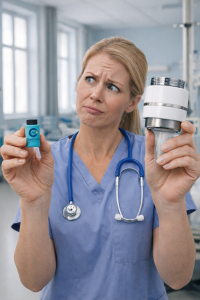
Healthcare providers invest significant sums responding to contamination after it has been discovered, yet comparatively little is often spent reducing the risk in the first place.
Solutions such as the Challis Ag+ Sentinel Tap Diffuser have been specifically designed to minimise the conditions that allow biofilm, limescale and microbial contamination to develop within tap outlets.
By combining antimicrobial protection with a design that reduces areas where bacteria can colonise, they provide an additional layer of defence at one of the most common points of contamination within a healthcare water system.
Would a Sentinel Tap Diffuser guarantee that an outbreak could never occur?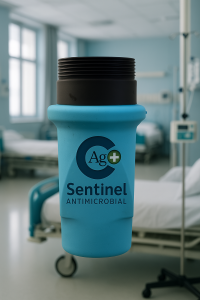
No responsible manufacturer could make that claim.
However, a relatively small investment in preventative technology at the point of use would most likely have significantly reduced the risk of contamination developing in the first place.
When compared with the potential £50,000-plus cost of investigating and managing a Pseudomonas incident, the economics become difficult to ignore.
Five contaminated taps can create a major operational headache for an NHS Trust.
Preventing those five taps from becoming contaminated in the first place is almost always the smarter investment.