
Sentinel™ Tap Diffusers: It’s Not Rocket Science. It’s Common Sense.
When it comes to controlling waterborne pathogens such as Pseudomonas 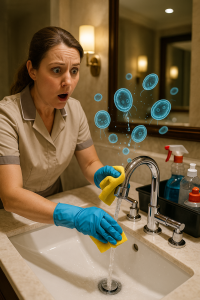 aeruginosa, Legionella and E. coli, the industry often has a habit of overcomplicating the problem.
Complex sink designs. Expensive filtration systems. Digital monitoring. UV technologies. Endless reports and studies.
Yet sometimes the most effective solutions come from stepping back and asking a simple question:
What is actually causing the problem?
For many years, investigations into contaminated outlets have repeatedly identified tap spouts and diffusers as a common location for biofilm formation and bacterial contamination. One of the key contributors is believed to be splash-back and aerosol contamination from basins and drains. Contaminated droplets can rise back towards the outlet, allowing microorganisms to colonise the diffuser and eventually migrate further into the tap body.
Once you understand the problem, the solution becomes remarkably straightforward.
Step One: Close the Door
The first issue is obvious.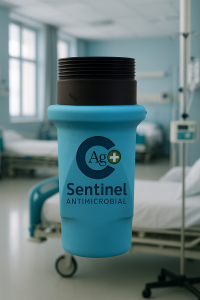
Most tap outlets are permanently open.
If contamination can enter through the outlet, why leave the outlet exposed when the tap isn’t in use?
The Challis Ag+ Sentinel™ Valve was developed around this simple principle. Its patented self-sealing valve opens when water flows and automatically closes when the water stops. The outlet is effectively sealed, helping to prevent contaminated aerosols and splash-back from entering the spout.
Not rocket science.
Just common sense.
Step Two: Make the Surface Hostile to Bacteria
Even with the outlet protected, surface contamination remains a possibility.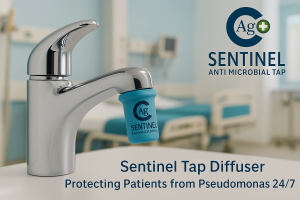
So the next logical step was to make the valve itself antimicrobial.
The Sentinel™ Valve is manufactured using medical-grade silicone incorporating antimicrobial silver-ion technology. Silver has been recognised for its antimicrobial properties for thousands of years and continues to be used extensively throughout healthcare and water treatment applications.
Again, this isn’t a revolutionary concept.
It’s a proven technology applied in a practical way.
Step Three: Add a Final Line of Defence
What if contamination somehow progresses further into the outlet?
The answer was to create an additional antimicrobial barrier.
This led to the development of the patented Sentinel™ silver-coated copper mesh “bullet” positioned within the valve assembly. The large surface area of silver and copper works continuously to create an environment hostile to bacterial proliferation. Both metals have well-established antimicrobial properties, disrupting cell membranes and inhibiting bacterial reproduction.
The result is a three-stage protection strategy:
- A self-closing valve to prevent retrograde contamination.
- Antimicrobial Ag+ silicone to reduce surface colonisation.
- A silver/copper mesh barrier providing additional protection deeper within the outlet.
Each element is simple.
Each element is proven.
And together they create a practical, affordable and easily retrofitted solution that can be deployed across an estate without major engineering works.
Common Sense Engineering
At Challis Ag+, we’ve always believed that innovation doesn’t have to mean complexity.
Sometimes the best ideas are the simplest.
Identify the source of contamination.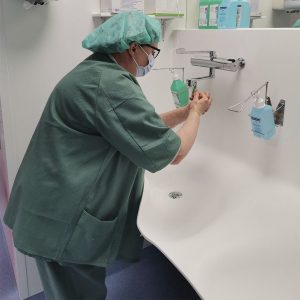
Understand how it occurs.
Apply proven technologies.
Build layers of protection.
That’s exactly what Sentinel™ does.
Of course, every healthcare environment is different, and every Water Safety Group must make its own decisions based on local risk assessments and operational requirements. Independent testing, published research and technical evaluation all have an important role to play.
But ultimately, the most meaningful test is often how a solution performs in the real world, in the environments where contamination risks exist every day.
Sentinel™ was developed to address a practical problem with a practical solution.
No complicated electronics.
No expensive infrastructure changes.
No rocket science.
Just common sense engineering designed to help protect patients, staff and facilities from the ongoing challenge of outlet contamination.