
A practical and holistic approach to immediate protection, remedial work and reducing the risk of recurrence
Imagine you manage a holiday park at the start of the summer season. A water sample from a shower has returned a concerning result. Guests are due to arrive. Your team needs to protect people, establish the extent of the problem and decide when the outlet can safely return to normal use.

A point of use (POU) filter may be an important part of that immediate response. Fitted to a suitable tap or shower, it provides a barrier at the place water is used while the wider issue is investigated.
But a difficult question follows: what happens when the filter is removed?

If the underlying cause has not been found and controlled, the same conditions may still be present. And even after successful remedial work, the outlet itself remains exposed to everyday use, splashes, handling and cleaning.
That is why Challis Ag+ and i3 Filtration offer a joined approach. i3 POU filters can help protect the point of use during a managed incident response. Remedial work addresses the cause. Sentinel tap and shower products then form part of the outlet’s ongoing risk controls.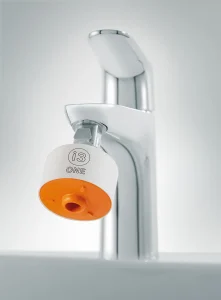
It is a practical sequence for people responsible for water safety in hotels, holiday parks, leisure facilities, student accommodation and other buildings with shared or intermittently used outlets. It also avoids asking one product to do every job.
The pressure on the person making the decision
A concerning water result rarely arrives at a convenient time. You may have a building full of occupants, a maintenance team already stretched, and colleagues who need an immediate answer about which facilities can remain open.
The first questions are usually straightforward: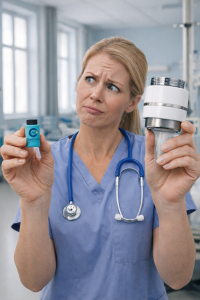
- Which outlets are affected?
- Who could be exposed?
- What can be used safely while we investigate?
- How quickly can we restore normal service?
- What will give us confidence that the problem will not simply return?
The answers require a site-specific risk assessment and a coordinated response. A positive result at one outlet does not, by itself, tell you whether the issue lies at the outlet, in the local pipework or further back in the water system. Nor should a clear result following treatment be treated as proof that every contributing condition has been removed.
The Health and Safety Executive’s guidance on legionella puts the emphasis on assessing risk, maintaining effective controls, taking appropriate action when problems are identified and reviewing whether those controls work. The duty to manage the water system continues throughout an incident.
A useful response therefore has three connected stages: protect people now, correct the underlying problem, and strengthen ongoing outlet management.
Stage one: protect the point of use
When an outlet presents an immediate concern, waiting for an investigation or remedial works to finish may leave too long a gap. Subject to the responsible person’s assessment, a suitable POU filter can help manage exposure at a designated tap or shower during that period.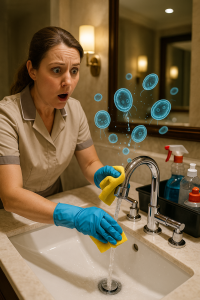
The filter sits at the final point before water reaches the user. Its job is to provide a microbiological barrier at that outlet. It does not disinfect a storage tank, correct poor temperatures or remove a dead leg. Its value is that it can provide an immediate, defined control where it is fitted and used correctly.
The i3 range includes tap and shower POU filters. i3 specifies a 50-day period of use for its i3 ONE tap filter and i3 TWO shower filter. Both use its pleated membrane technology. The manufacturer also explains that the filter’s outer surface and the risk of retrograde contamination matter when deciding how long a filter can remain in service.
For an estates or facilities team, the practical benefits are clear. A suitable filter can allow a controlled response at a specific outlet while sampling, investigation and corrective work proceed. The defined service life also gives the team a replacement date to record and manage.
Those details matter. An emergency measure is only reassuring when people know where it has been installed, what it protects, when it must be changed and who is responsible for checking it. The UK medicines regulator advises purchasers to examine the full product information when selecting a POU filter for the intended setting and use.
A filter is an excellent tool for the right moment. The mistake is allowing its presence to become the entire plan.
Stage two: find out why the problem appeared
Consider a shower block that is quiet for much of the year and then sees intensive use during peak season. Or a hotel wing that has reopened after refurbishment. Or a student accommodation building where some rooms have been empty for weeks.
Patterns of use can change the conditions inside a water system. Temperature control, stagnation, little-used outlets, pipework layout, maintenance and the condition of terminal fittings all warrant attention. HSE guidance identifies poor flow and unused sections of pipework among the matters to consider when controlling legionella in hot and cold water systems.
The investigation should establish the extent of the issue and the likely contributing causes. Depending on the site and the organism identified, the response may involve further sampling, checks on temperatures and flow, inspection of outlets and fittings, cleaning, disinfection, repair or changes to the management regime. The responsible person and competent specialists should decide what is appropriate for the building.
This is where POU filtration has a distinct role: it helps manage risk during the work; it is not evidence that the work is complete.
That distinction is especially important when a filter has helped a facility remain operational. Success at the filtered outlet can bring understandable relief. Yet the filter may be doing precisely what it was installed to do: providing a final barrier while an upstream or local problem still needs attention.
Before a filtered outlet returns to ordinary operation, the team needs a decision based on the investigation, the remedial actions taken, the relevant verification and the site’s water safety arrangements. There is no single product-led timetable that can make that decision for every building.
Stage three: consider what happens at the outlet afterwards
Even when the wider water system is back under control, the outlet deserves attention.
Taps and showers are exposed to their surroundings. They are touched, cleaned  and used in ways that can introduce contamination around the terminal fitting. A tap diffuser, shower head or hose may also have surfaces and internal features that make its condition important to the overall water safety plan.
Challis developed its Sentinel range with this outlet-level challenge in mind. The Sentinel Tap Valve is designed to replace the internals of a compatible tap diffuser. Its design includes a self-sealing duckbill valve intended to reduce backward ingress at the outlet, alongside antimicrobial components. The wider Sentinel range includes shower heads and hoses designed as part of a managed replacement scheme. Challis describes the purpose of the range as reducing the risk associated with back contamination and outlet colonisation.
These products address a different part of the problem from a POU filter. A filter provides a defined barrier to bacteria in water delivered through that filtered outlet during its service life. Sentinel products are intended to reduce the opportunity for contamination to enter or establish itself at the terminal fitting during ordinary use.
They can therefore be considered after the incident has been addressed and the outlet is ready to return to its planned operating regime. Installation should follow the product instructions and the site’s assessment of compatibility and risk. Cleaning, maintenance, temperature management, flushing where required and other water safety controls remain essential.
No outlet fitting can guarantee that Pseudomonas or Legionella will never be detected again. The credible goal is to remove the causes identified in the investigation and reduce avoidable routes for a future problem to take hold.
Why filters alone leave an important question unanswered
There is nothing wrong with relying on a POU filter for the job it was selected to do. Problems arise when it becomes a substitute for a longer-term decision.
Imagine that an affected shower receives a filter. Users are protected at that 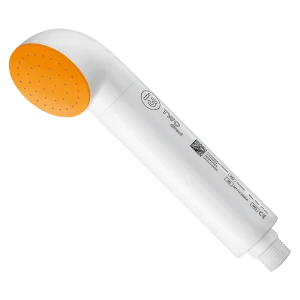 point of use under the site’s agreed arrangements. Remedial work follows, and the team decides the filter can come off.
What has changed at the outlet itself?
Perhaps the investigation found and corrected a temperature issue. Perhaps contaminated fittings were replaced. Perhaps the cleaning and maintenance schedule has improved. These are meaningful steps. But if the original terminal arrangement remains particularly exposed to splash, handling or back contamination, it is reasonable to ask whether an additional outlet-level control would help.
Keeping POU filters in place indefinitely is another possible decision in some circumstances, but it carries an ongoing management commitment. Filters must be installed correctly, changed within their specified life, handled appropriately and recorded. Teams need to consider flow, compatibility and the condition of the exterior of the device. i3’s 50-day use period, for example, is a planned replacement interval, not a “fit and forget” arrangement.
For an operator with many taps and showers, those recurring tasks can become substantial. That does not make filters the wrong choice. It makes it important to be clear about which outlets need filtration, for how long and what the intended next step will be.
A considered plan may use i3 filters during an incident, retain them longer at selected outlets where the risk assessment supports that decision, and introduce Sentinel products at suitable outlets as part of routine management. The mix depends on the building and its users.
Pseudomonas and Legionella are not the same problem
These organisms are often mentioned together in discussions about water safety, but they should not be treated as interchangeable.
Legionella risk is closely associated with water systems that allow the bacteria to multiply and with exposure to contaminated aerosols, including those generated by showers. Control therefore depends heavily on the design, operation and maintenance of the wider system. HSE guidance covers the assessment and control of those risks across workplaces and other premises.
Pseudomonas aeruginosa can present particular challenges around outlets and biofilm. The best-known detailed UK guidance on managing it at water outlets was developed for healthcare settings, especially augmented care. That guidance should not be presented as a blanket legal requirement for a hotel, holiday park or leisure centre. It does, however, illustrate why the condition and use of terminal fittings can matter when investigating persistent contamination.
For a non-healthcare operator, the response needs to match the actual organism, the affected water system, the routes of exposure and the people using the building. The point of combining filters, remedial work and outlet controls is to give each of those decisions a clear place.
What a joined response can look like
Picture a holiday park with a concerning result associated with a communal shower outlet. Guests are using nearby facilities, and closing the entire block would cause significant disruption.
The operator’s first step is to follow its water safety arrangements and obtain 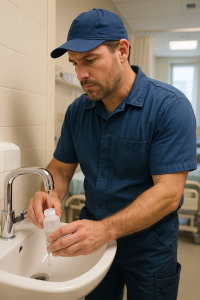 competent advice on the result. The team assesses which outlets can remain available, which must be restricted and where suitable POU filtration could form part of interim protection. Each installed filter is recorded, with a clear change date and instructions for staff.
At the same time, the team investigates. It reviews the affected outlets, temperatures, usage patterns, pipework and maintenance records. It carries out the remedial actions indicated by the findings and verifies the outcome under its agreed plan.
Only then does it decide how the outlets should operate in the longer term. Some may continue to need filters. Others may return to normal service. At compatible taps and showers, the operator considers Sentinel products to help address outlet-level back contamination as part of planned maintenance.
That approach gives the facilities manager a coherent account of the response:
- People were protected while the issue was investigated.
- The underlying conditions were examined and corrected.
- The outlets’ future maintenance and protection were reviewed.
It is a stronger operational position than “we fitted filters and waited for the next sample”, because it deals with the period during an incident and the period after it.
The same thinking can apply in a hotel, a leisure centre or student accommodation. The exact measures will differ. The sequence remains useful.
The commercial case: fewer open-ended decisions
A water incident has costs beyond the immediate technical work. There may be closed facilities, disrupted guests or occupants, staff time, repeat visits, replacement fittings and pressure on the people accountable for the building.
A joined approach helps by making the purpose of each spend easier to explain.
POU filters support immediate, targeted action. Where appropriate, they can provide a defined barrier at selected outlets while investigations continue.
Remedial work addresses the cause. It is the work that determines whether the conditions behind the incident have been brought under control.
Sentinel products support the longer-term outlet strategy. At suitable fittings,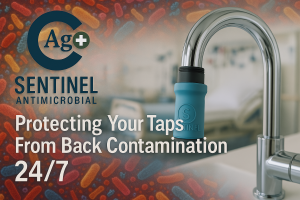 they provide a further way to address the risk of back contamination during routine use.
That does not mean every outlet needs every product. It means each measure should earn its place in the risk assessment. An operator may find that targeted protection is more manageable than fitting filters everywhere indefinitely. Equally, a higher-risk outlet may justify continued filtration even after other improvements have been made.
The commercial benefit is not a promised saving on every site. It is the ability to make proportionate decisions, plan replacement cycles, explain why controls are in place and avoid drifting into a costly interim arrangement with no agreed end point.
The questions worth asking before the next incident
If you are responsible for a large estate, the best time to think through these choices is before you are under pressure from an unexpected result.
Start with the outlets that would cause the greatest difficulty if they were taken out of service. Think about showers in guest accommodation, communal changing rooms, heavily used washrooms and facilities used by people who may be more vulnerable. Then ask:
- Do we know which outlets we would prioritise for interim protection?
- Have we checked which tap and shower filter connections are suitable?
- Who would authorise installation, monitor use and arrange replacement?
- How would we investigate beyond the individual positive outlet?
- What evidence would we require before removing a filter?
- Have we considered the condition and design of the terminal fittings afterwards?
- Can we show, from our records, what we did and why?
These are practical management questions. Clear answers can save valuable time when a result arrives.
Protection should have a beginning, a middle and a future
There is a natural urge to find one decisive fix for a recurring water hygiene problem. In practice, the better answer is often a sequence of well-chosen controls.
An i3 POU filter can help provide immediate protection at an appropriate tap or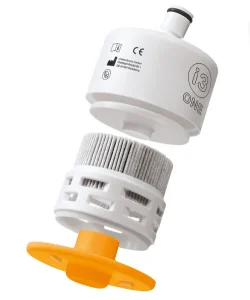 shower while the situation is assessed and managed. Competent investigation and remedial work then address what caused the problem. Sentinel tap and shower products can form part of the subsequent outlet strategy, helping reduce the risk of back contamination alongside the building’s established water safety measures.
That is the thinking behind bringing the two ranges together. The filter helps you manage today’s exposure. The investigation tells you what must change. The outlet plan helps you manage tomorrow.
If you are dealing with repeat positive results, or you want a clearer response plan before the next one, speak to Challis Ag+ about the affected outlets and the way your building is used. We can help you assess where i3 POU filters and Sentinel products may fit within a practical, site-specific water safety plan.