
The challenge isn’t managing one shower. It’s knowing that every shower, in every accommodation unit, across every park, is safe and ready for the next guest—and being able to prove it.
Why Not Watch Our New Video First Click Here
For an estates or facilities manager responsible for a large holiday park, water safety probably feels deceptively simple from the outside.
Turn on the tap. Check that the water is hot. Make sure the shower works. Clean the accommodation. Welcome the next guests.
But you know the reality is rather different.
You may be responsible for hundreds—or even thousands—of individual showers spread across caravans, lodges, changing rooms, swimming facilities, staff areas and communal buildings.
Some will be used several times a day. Others may remain unused between bookings. Some accommodation will be owned and occupied regularly, while other units may stand empty for weeks. Maintenance may be undertaken by different teams, contractors or owners, using components purchased at different times from different suppliers.
The challenge is not simply keeping the water flowing.
It is controlling the risk created by fluctuating occupancy, stagnant water, inconsistent temperatures, ageing components, retained water, scale and biofilm—without creating an administrative system so complicated that it becomes difficult to operate.
That raises an uncomfortable but important question:
How confident are you that every shower across your estate is safe, compliant and ready for use today?
And perhaps the more difficult question:
If an incident occurred, could you prove it?
This is not about suggesting that holiday parks are unsafe. Well-managed parks already invest considerable time, money and expertise in protecting guests and employees.
It is about recognising the particular water-safety challenges created by large, dispersed and seasonally occupied estates—and making those challenges easier to control.
The reassuring news is that the solution does not have to be disruptive, expensive or complicated.
Why holiday accommodation creates a distinctive water-safety challenge
A single caravan or lodge normally has a relatively straightforward domestic water system. Looked at in isolation, the risk may appear modest.
The challenge changes when that one unit becomes part of an estate containing hundreds of individual systems.
Every unit may contain:
- A showerhead and flexible hose
- A hot-water appliance
- Hot and cold distribution pipework
- Taps and kitchen outlets
- A thermostatic or mechanical shower control
- Little-used connections or external taps
- Components fitted at different points in the unit’s life
- Sections of pipework where water can remain between occupancies
Multiply that by several hundred units on one park—and then by a national portfolio of parks—and a simple maintenance task becomes a significant asset-management exercise.
The Health and Safety Executive makes the underlying responsibility clear: employers and people in control of premises must assess and manage foreseeable risks from exposure to Legionella.
HSE guidance also identifies several familiar risk factors, including little-used outlets, dead legs, water temperatures that support bacterial growth, thermostatic mixing valves and systems where water can stagnate.
For holiday parks, these conditions can arise naturally because occupancy is not constant.
A caravan may be fully occupied one week, empty the next and then prepared quickly for another family. During the closed season, large parts of a park may be drained down, isolated or left unused before being recommissioned.
That cycle creates an operational problem that conventional approaches do not always make easy to manage.
The hidden risk of intermittent occupancy
Regular water movement is an important part of maintaining a healthy water system.
When outlets are used frequently, fresh water moves through the pipework. When a caravan or lodge remains vacant, water may sit within branches, valves, shower hoses and showerheads.
This stagnation can contribute to conditions in which microorganisms and biofilm become established—particularly when water temperatures are favourable.
HSE guidance states that cold water should, where possible, be kept below 20°C. Hot water used as the primary control should generally be stored at a minimum of 60°C and distributed so that it reaches 50°C within one minute at outlets.
Those principles can become harder to maintain in holiday accommodation.
Caravans and lodges may have pipework running through shallow ducts, enclosed voids or external service routes. During warm weather, cold-water temperatures may rise. During quiet periods, there may be insufficient water movement to replace warmed or stagnant water promptly.
Small water heaters, varying demand and individual unit configurations can also affect hot-water performance.
None of this automatically means that an unsafe condition exists. It does mean that occupancy patterns and temperature performance need to be understood, controlled and recorded.
Why the shower deserves particular attention
Water may be consumed from taps, but showers create fine droplets and 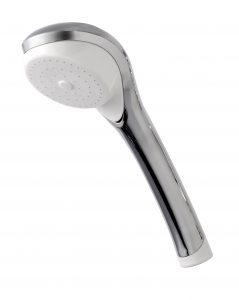 aerosols that can be inhaled.
That makes the final part of the shower assembly—the mixer, hose and showerhead—an important point of control.
A shower hose is not simply a passive tube.
Its internal surface may retain moisture after use. Scale, sediment and organic material can accumulate. Flexible internal surfaces and complex showerhead waterways can provide areas in which biofilm develops.
External cleaning may leave a shower looking immaculate while doing little to address what is happening inside the hose or showerhead.
That distinction matters.
Guests judge cleanliness by what they can see. Water-safety professionals must also consider what cannot be seen.
A beautifully prepared caravan can still contain a shower assembly that has been in service for years, has no clear replacement history or has spent extended periods holding stagnant water.
For estates and facilities teams, that creates a difficult balance. Showerheads and hoses must be safe, reliable and simple to maintain—but also commercially realistic to replace across a substantial estate.
Cleaning is valuable—but it is not the whole answer
Cleaning and descaling showerheads can form part of a suitable control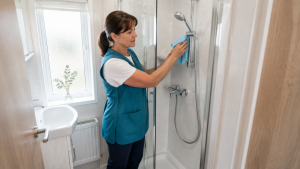 programme.
However, the process must be completed correctly and consistently. Components may need to be removed, dismantled, treated, rinsed, dried and refitted. Chemicals require appropriate handling, storage, concentration control and COSHH procedures.
The true cost is therefore considerably greater than the price of the cleaning product.
It includes:
- Maintenance and housekeeping time
- Training and supervision
- Chemical purchasing and storage
- Protective equipment
- Safe handling procedures
- Dismantling and reassembly
- The risk of parts being damaged or refitted incorrectly
- Record keeping
- Quality checks
- The operational cost of taking an outlet out of service
When hundreds of showers are involved, small inconsistencies become significant.
Was the hose cleaned as well as the head?
Was the component dismantled properly?
Was the correct chemical concentration used?
Was the required contact time achieved?
Was it rinsed and dried correctly?
Was it returned to the right accommodation unit?
Was the work recorded against the correct asset?
A procedure can be perfectly written but still become unreliable when it depends on many people completing numerous manual steps under time pressure.
This is where simplification becomes a valuable form of risk reduction.
The difference between having a procedure and having proof
Most established holiday operators will already have water-safety policies, risk assessments and maintenance procedures.
The problem is rarely a complete absence of paperwork.
The more common concern is whether the process provides an accurate, current picture of every outlet.
A spreadsheet may say that a block of caravans was inspected. A paper record may confirm that flushing took place. A contractor may submit a job sheet showing that showerheads were changed.
But can the information answer the questions that matter following an incident?
- Which showerhead and hose were installed in the unit?
- When were they installed?
- Were they approved for use with wholesome water?
- When was the outlet last flushed?
- Who completed the work?
- Was the correct replacement cycle followed?
- Were any faults identified?
- Were remedial actions completed?
- Can the evidence be retrieved quickly?
- Is the record tied to the individual caravan, lodge and outlet?
If the answer requires several people to search through different systems, paper records and contractor reports, the organisation may have a process—but not complete control.
Good water-safety management should provide both protection and evidence.
The two belong together.
The risk of inconsistent replacement products
Large estates naturally accumulate variation.
One park may use one type of shower. Another may use a different model.  Replacement hoses may be purchased locally when stock runs short. A contractor may fit the nearest available alternative to return accommodation to service quickly.
Over time, the estate can acquire a mixture of:
- Different showerhead designs
- Different hose materials and internal constructions
- Different flow rates
- Components with uncertain approval status
- Products with different cleaning requirements
- Showerheads without an identifiable installation date
- Components sourced through several supply chains
This can make purchasing look flexible, but it introduces complexity.
Each additional product potentially requires separate verification, instructions, stockholding and maintenance decisions. It also becomes harder for employees to recognise whether the correct component has been fitted.
A standardised shower specification removes much of that uncertainty.
The maintenance team knows what to fit. Procurement knows what to order. Health and safety know what has been approved. Estates teams know the intended replacement cycle.
Simplicity makes compliance more repeatable.
Water safety must also consider scalding
Microbiological control is only one side of the equation.
Hot water must be maintained at temperatures that help control Legionella, while 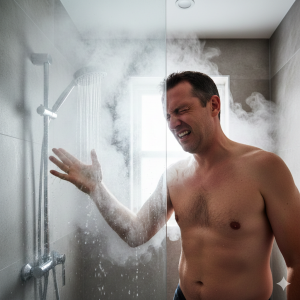 the temperature delivered to a guest must not create an unacceptable scalding risk.
This is particularly important in family accommodation used by young children, older guests and people with disabilities or reduced mobility.
Thermostatic controls can help manage this balance, but they require correct specification, commissioning, maintenance and testing. If an unsuitable or poor-quality product is fitted, temperature stability and fail-safe performance may be compromised.
Pressure fluctuations can add another layer of difficulty, especially at busy times when demand changes rapidly across a park.
A safe showering strategy should therefore consider the complete outlet:
- Hot-water generation
- Distribution temperatures
- Cold-water temperatures
- Shower valve performance
- Scald protection
- Shower hose condition
- Showerhead condition
- Flow performance
- Cleaning and replacement
- Traceable records
Focusing on only one element may leave the wider risk unresolved.
Communal facilities increase the scale of exposure
Accommodation is only part of a holiday park’s water system.
Swimming pools, changing areas, shower blocks, restaurants, staff facilities and touring pitches all create additional outlets and patterns of use.
Communal showers may experience intensive demand during peak periods followed by reduced use during quieter weeks. Outdoor facilities may be affected by seasonal temperatures and winter shutdowns. Touring-pitch taps and hose connections may be exposed to contamination or inappropriate guest use.
Hot tubs require especially careful management. The HSE identifies spa pools as a recognised potential source of infection because they combine warm water, aeration, high bather loading and aerosol generation.
This reinforces an important point: a park’s water-safety plan needs to account for different types of system rather than treating the entire estate as one uniform environment.
The control measures suitable for a caravan shower may not be sufficient for a hot tub or communal changing facility.
However, one principle applies everywhere:
The simpler the control is to understand, implement and verify, the more dependable it is likely to become.
What would a straightforward solution look like?
The answer is not necessarily another complicated management platform or a maintenance regime that adds hours of work to every changeover.
A practical solution can begin with three simple objectives:
- Standardise the shower products being used.
- Make replacement and inspection visually obvious.
- Create a clear record linked to each accommodation unit.
This can be implemented gradually rather than through a disruptive estate-wide replacement programme.
As existing showerheads and hoses reach their scheduled replacement date, they can be exchanged for a standard approved product. Each caravan or lodge can be given a unique asset identity, with future work recorded against it.
The result is a controlled transition towards a consistent estate.
Standardise the final outlet
Challis manufactures shower heads and hoses in the UK for environments where safety, reliability and auditability matter.
Our antimicrobial shower products are manufactured using silver-ion technology designed to provide ongoing antimicrobial action within the product.
The Challis Sentinel system adds a copper mesh structure within the shower hose. The copper remains in contact with water moving through the hose and is intended to provide an additional defence against microbial contamination and biofilm development.
The objective is reassuringly simple: improve protection at the point where water finally reaches the user, without creating a difficult maintenance burden.
A standard shower specification can provide:
- Consistent product quality
- A defined replacement programme
- Clear purchasing control
- Reduced reliance on locally sourced alternatives
- Easier staff training
- Simplified stockholding
- Greater visibility across the estate
- A common approach for employees and contractors
- UK-based supply and technical support
This does not replace a suitable risk assessment or wider control programme. It strengthens the final outlet within that programme.
Make compliance visible
One of the simplest features can also be one of the most useful.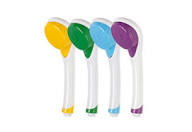
Challis showerheads are available with clear colour identification. Colours can be assigned to replacement periods, making it easier for employees to see whether the correct showerhead is installed.
A facilities manager can walk into an accommodation unit and immediately identify whether the shower appears to be within the planned cycle.
There is no need to remove the fitting, search for a tiny date code or access a separate system before noticing a potential discrepancy.
Visual identification supports—not replaces—digital records. It creates an immediate first-line check.
That is particularly valuable when large numbers of accommodation units must be inspected during busy changeover periods.
The principle is uncomplicated:
If compliance can be seen, it is easier to manage.
Give every unit a simple digital record
A QR-based asset record can link maintenance activity directly to an individual 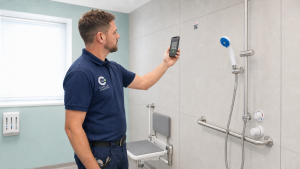 caravan, lodge or group of outlets.
A member of the maintenance team scans the code using a smartphone and records the task. That could include:
- Flushing completed
- Temperature checked
- Showerhead replaced
- Hose replaced
- TMV inspected
- Fault identified
- Remedial action completed
- Unit recommissioned
- Photograph or supporting evidence added
The information becomes part of a live record rather than another sheet of paper to be processed later.
Managers can then see what has been completed, what is due and where action is required.
This helps move the organisation away from retrospective evidence gathering and towards real-time control.
It can also reduce duplication. The same record can support maintenance planning, compliance reporting, contractor management and stock forecasting.
Focus people on the exceptions
The purpose of a digital system should not be to burden employees with more administration.
It should make their work easier.
A well-designed process allows teams to complete routine tasks quickly and draws management attention to the exceptions:
- A unit that has remained vacant
- A flush that has been missed
- An outlet with an abnormal temperature
- A showerhead that is outside its replacement cycle
- A recurring fault
- A component that does not match the approved specification
- A task that has been recorded but not verified
Estates managers do not need more data for its own sake. They need clear information that helps them decide where intervention is required.
The best compliance system is often the one that remains almost invisible when everything is working correctly.
Prevention can cost less than reaction
It can be tempting to view planned shower replacement or asset tracking as an additional expense.
A more complete calculation tells a different story.
The true cost of an uncontrolled incident may include:
- Emergency water sampling
- Specialist investigation
- Immediate remedial work
- Chemical or thermal disinfection
- Replacement of shower equipment
- Temporary closure of accommodation
- Relocating or compensating guests
- Lost booking revenue
- Contractor call-outs
- Management time
- Regulatory scrutiny
- Insurance involvement
- Complaints and negative reviews
- Reputational damage
- Loss of confidence among guests and owners
Against those costs, a planned and standardised prevention programme can be remarkably economical.
It also creates operational savings by reducing uncertainty, simplifying purchasing, making maintenance quicker and improving the accuracy of records.
The commercial question is not simply, “What does the shower cost?”
It is:
“What does this shower help us prevent, simplify and prove?”
Do you really need a complicated estate-wide project?
It would be understandable if the prospect of changing a national shower specification felt disruptive.
It does not have to be.
A sensible implementation can begin with a controlled trial at one park, one accommodation category or a selected group of higher-risk units.
For example:
- Identify accommodation with intermittent use or recurring maintenance concerns.
- Record the existing shower equipment and replacement history.
- Install a standard Challis showerhead and hose.
- Introduce simple colour-coded identification.
- Add a QR asset record to each selected unit.
- Measure replacement time, maintenance activity and employee feedback.
- Review the results before extending the programme.
This provides evidence under real operating conditions without requiring a large initial commitment.
It also gives the estates, health-and-safety, procurement and operational teams an opportunity to agree a common specification together.
A practical prevention model for holiday parks
An effective programme could be built around five straightforward stages.
1. Know what is installed
Create a basic asset record showing the showerhead, hose, mixer and relevant water-heating arrangement within each unit.
Perfect data is not required on day one. The record can be built during routine maintenance visits and changeovers.
2. Standardise replacement components
Approve a small range of suitable showerheads, hoses and valves for defined applications.
Prevent uncontrolled substitution by making the approved products readily available to park maintenance teams and contractors.
3. Establish a risk-based replacement cycle
Set replacement intervals based on the product, occupancy pattern, water quality, manufacturer’s guidance and site-specific risk assessment.
Use clear colour identification so that overdue components are easier to recognise.
4. Record activity at the point of work
Allow employees or contractors to scan the accommodation asset and record the completed task immediately.
Avoid relying on memory, handwritten notes or information entered into another system days later.
5. Review exceptions and trends
Use the information to identify recurring failures, unusual temperatures, missed work and units generating disproportionate maintenance costs.
This transforms compliance information into a practical management resource.
Peace of mind is a commercial outcome
Facilities and health-and-safety teams are often expected to deliver two things  that appear to conflict: stronger protection and lower operating costs.
A well-designed prevention programme can support both.
Standardisation reduces purchasing complexity. Visual identification accelerates inspection. Digital records reduce administrative effort. Planned replacement reduces emergency call-outs. Better components can extend dependable performance. Clear evidence reduces uncertainty following a complaint or investigation.
Most importantly, the organisation gains confidence.
Confidence that the correct product has been installed.
Confidence that the outlet has been maintained.
Confidence that the replacement cycle is being followed.
Confidence that missed tasks will be visible.
Confidence that evidence can be produced quickly.
That is what we mean when we say:
We do not simply supply showers. Our showers come with peace of mind and the quiet confidence of a job well done.
The next guest should never inherit the last guest’s risk
Every new arrival expects their accommodation to be clean, comfortable and ready.
They will probably never think about the water sitting behind the showerhead. They should not have to.
That responsibility sits with the people working quietly behind the scenes: water-safety specialists, facilities managers, engineers, housekeeping teams, health-and-safety leaders and contractors.
Those teams already carry a considerable operational burden. The answer is not to give them a more complicated process. It is to provide better products, clearer standards and simpler evidence.
For a large holiday-park operator, perfection does not come from asking employees to remember more.
It comes from designing a system in which the correct action is easy to take, easy to recognise and easy to prove.
That means:
- A consistent shower specification
- Antimicrobial protection at the final outlet
- Components designed for the environment
- A visible replacement programme
- Straightforward asset identification
- Digital maintenance records
- Clear responsibilities
- Reliable UK supply
- A gradual, cost-effective implementation plan
None of these measures needs to disrupt the guest experience.
In fact, the guest may never notice them.
They will simply turn on the shower and enjoy their holiday—confident that everything is as it should be.
And behind that ordinary moment sits something extremely valuable: a controlled process, a dependable product and an estates team able to demonstrate that the work was completed properly.
A simple place to start
If you manage a holiday park, lodge estate or other seasonally occupied accommodation, begin with three questions:
Do we know exactly which shower products are installed in every unit?
Can we see immediately whether each showerhead and hose is within its intended replacement cycle?
Could we retrieve a complete maintenance record for a particular unit within minutes?
If any answer is uncertain, that does not mean the entire water-safety programme needs to be rebuilt.
It simply identifies an opportunity to make control easier.
Challis can help assess the existing shower estate, develop a standard product specification and introduce a practical replacement and asset-recording programme.
The approach can start small, work alongside existing water-safety arrangements and expand only when the results have been demonstrated.
No unnecessary complexity.
No sweeping change for the sake of it.
Just a cost-effective, straightforward method of strengthening prevention at the final outlet—and providing the evidence that the job has been done.
Because the challenge is not managing one shower.
It is knowing that every shower, in every accommodation unit, across every park, is safe and ready for the next guest—and being able to prove it.
That is not merely compliance.
It is peace of mind—and the quiet confidence of a job well done.
Help Us To Grow by telling Google we are your preferred source for this type of information by Clicking Here
Call us for a free trial on 01628 529024 or email: info@challisms.com